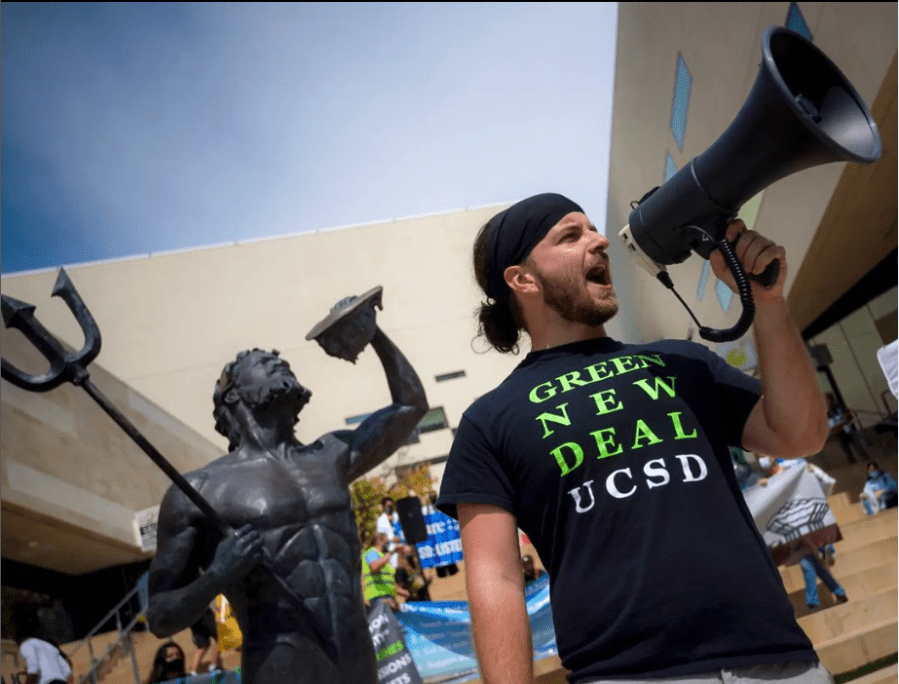
Interview with Adam, a PhD student and climate organizer, age 27 in California.
What brought you into climate work and the climate movement?
I began my PhD in Atmospheric Chemistry at UCSD coming from an environmental justice background (water quality) but hadn’t really been exposed to the broader climate community. A series of triggering events in my second year of grad school got me involved in climate organizing. The first was the global School Strike for Climate in September 2019, which got me out of the lab and into the streets for the first time. Hearing a climate professor (Dr. Ramanathan) speak on the necessity for climate scientists to take action was really inspiring. Simultaneously, taking a climate policy course which detailed my own institution’s history in supporting climate denial, even as we maintained the Keeling Curve, showed me that university campuses can be the front lines for shaping climate policy & discourse.
The COVID lockdowns & the murder of George Floyd shook me out of my focus on my university and brought me into the greater justice movement in San Diego, where I was onboarded and trained by the Sunrise Movement. This community has been the backbone of my involvement in climate justice and has shaped my approach to community organizing.
What do you think is the best reason to support taking action to combat climate change? (e.g. clean air, future generations?)
The best reason to take climate action is personal to each individual and it involves identifying their individual stake in their community and collective future. Altruistic activism does not last because it doesn’t bring the type of buy-in needed to sustain effort. For me, I’m motivated by my experience being displaced by a climate crisis enhanced hurricane and my desire for a more resilient society where communities come together after disasters. I’m also grounded in the communities where I do work on exposure to environmental pollutants and can see that the only way to tackle the twin crises of climate change and pollution is to address both at the same time. I think a centralizing theme to most folks taking action is that it is the best antidote to climate grief and despair, which also emerge individually based on the circumstances of each person.
How would you describe your approach to organizing and mobilizing young people and students on climate?
I organize with the momentum model, which relies on performing an action to bring the crisis to the public, identifying and onboarding interested new members from the crowd, and training them to take further action which will repeat the cycle. Particularly on campus, this involves sustained and regular protest in active areas and a robust system of teams with “bite-sized” roles and tasks to support larger campaigns.
How has organizing changed for you during the pandemic, and have you noticed any similar changes with the activists you work with?
My involvement with organizing was limited to being a passive member before the pandemic, and the pause and reevaluation of time and priorities has allowed me to give more time and labor to the movement. I’ve noticed the folks who organized together during the early onset of the pandemic through 2021 form an “old guard” in the movement spaces I’m in, as there was a regular presence and community building within the confines of COVID-era restrictions. It has been difficult to build back up to both the number of folks involved pre-pandemic during the whirlwind action of 2019 and the sense of community that emerged when folks’ social groups were very concentrated and action oriented during the uprising and election of 2020.
Does the federal government’s response to the COVID pandemic give you any more or less confidence in their ability to address climate change?
Many people, including myself, had bright visions of responding to the pandemic in transformative ways – propped up by the mass turnout of people in 2019 and the energy from Bernie’s 2020 run. I believe the federal response solidified my view of the USA’s power to respond to crisis, and inability to use the period of support for massive investments to fundamentally change anything. If a pandemic didn’t result in universal healthcare, what will? If a climate crisis and the IRA bill didn’t result in the phaseout of fossil fuels, what will? Answering this question is complex – I believe more in our ability to respond to disaster, but I believe less in our ability to avoid it.
How about the public’s response, and young peoples’ handling of it?
I’m really proud of the two generational groups I straddle (millennials and gen z,) particularly the general acceptance of pandemic restriction and prevention efforts. I think that can be characterized by the “stickiness” of the millennial group becoming less conservative as they age compared to other generational cohorts. This gives me generally more confidence in the ability to address climate change, although I am still hesitant to what the response will be when climate policy requires sacrifice similar to or more than the restrictions imposed by the COVID lockdown.
How do you feel about the Biden-Harris Administration’s approach to climate action, and any actions they’ve taken thus far?
I’m generally supportive of the Biden-Harris approach when it comes to supporting clean energy and centering environmental justice in any climate policies. However, their inability to phase out fossil fuels and the continuous approval of new fossil fuel developments highlights their priorities of increasing technology development and clean energy infrastructure without taking any action that risks potential sacrifice from everyday people. I think this is mostly politically motivated, as most elected governments avoid making short term sacrifice (gas prices going up, electricity bills getting higher) for long term climate stabilization. I do think they have been responsive to the climate movement, including providing access to movement leaders and the promotion of favored policies like the Climate Corps jobs development program.
How about Congress? (If you’ve been following?)
In general, Democrats in Congress seems fairly in line with the Biden-Harris Administration with obvious deviations (progressives calling for more transformative changes, Manchin/Sinema watering down climate bills.) I’m supportive of the Green New Deal policy packages that touch beyond “typical” climate policies, like GND for Public Schools and GND for Housing. I think the branding of policies for social good within the context of the climate crisis will, over time, lead to a more intersectional lens for these progressive policies.
Do you personally believe you have the ability to affect change on the issues that you most care about?
Yes, I’ve been absolutely blessed by the platform I’m afforded as a PhD Student at UCSD and the spaces I’ve been able to access through my work in community organizing (including advocacy at the local, state, national and international level.) I’ve seen the impact of my work in state and federal budgets ($13M for University of California decarbonization planning, $300M for Tijuana River Valley remediation) and I’ve been in negotiating positions within the UC system (campus electrification task force) and at the United Nations (Global Framework on Chemicals).
Have the experiences in the past year given you any more or less confidence in this?
I’ve gained confidence in the last year as I’ve seen the results of campaigns start winning (American Climate Corps) and the placement of more movement leaders in positions of decision-making and influencing power (mostly within the UC system.)
What role do you think the youth climate movement should play moving forward, and how confident are you in its ability to have a significant impact?
The youth climate movement is in an interesting place where climate disasters continue to worsen while being normalized. As we enter an era of geopolitical conflict, the resurgence of fascism and other crises which aren’t on the surface related to climate, national and international climate movements may need to focus on coalition work as other issues become more highlighted in the public consciousness.
I believe the best path forward for individuals is to hyper-localize climate action to build and strengthen our communities while maintaining a national and international network to learn, share and celebrate. When the whirlwind moment with global attention on climate returns, we should be equipped with models of success and have built broad public support.
 Climatennials