Featured

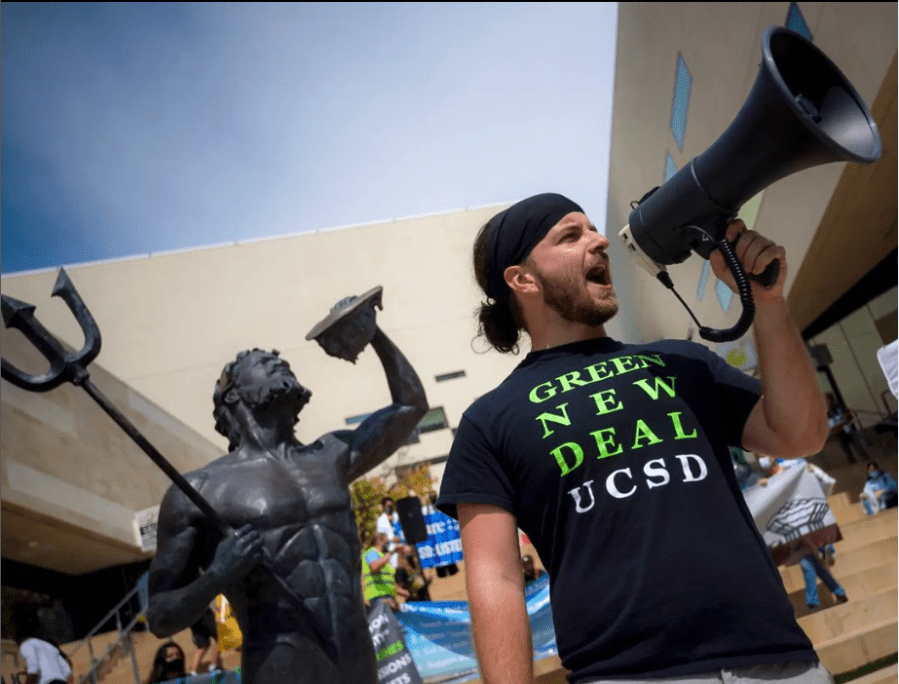
Adam Cooper, student activist

Interview with Adam, a PhD student and climate organizer, age 27 in California.

What brought you into climate work and the climate movement?

I began my PhD in Atmospheric Chemistry at UCSD coming from an environmental justice background (water quality) but hadn’t really been exposed to the broader climate community. A series of triggering events in my second year of grad school got me involved in climate organizing. The first was the global School Strike for Climate in September 2019, which got me out of the lab and into the streets for the first time. Hearing a climate professor (Dr. Ramanathan) speak on the necessity for climate scientists to take action was really inspiring. Simultaneously, taking a climate policy course which detailed my own institution’s history in supporting climate denial, even as we maintained the Keeling Curve, showed me that university campuses can be the front lines for shaping climate policy & discourse.

The COVID lockdowns & the murder of George Floyd shook me out of my focus on my university and brought me into the greater justice movement in San Diego, where I was onboarded and trained by the Sunrise Movement. This community has been the backbone of my involvement in climate justice and has shaped my approach to community organizing.

What do you think is the best reason to support taking action to combat climate change? (e.g. clean air, future generations?)

            The best reason to take climate action is personal to each individual and it involves identifying their individual stake in their community and collective future. Altruistic activism does not last because it doesn’t bring the type of buy-in needed to sustain effort. For me, I’m motivated by my experience being displaced by a climate crisis enhanced hurricane and my desire for a more resilient society where communities come together after disasters. I’m also grounded in the communities where I do work on exposure to environmental pollutants and can see that the only way to tackle the twin crises of climate change and pollution is to address both at the same time. I think a centralizing theme to most folks taking action is that it is the best antidote to climate grief and despair, which also emerge individually based on the circumstances of each person.

How would you describe your approach to organizing and mobilizing young people and students on climate?

I organize with the momentum model, which relies on performing an action to bring the crisis to the public, identifying and onboarding interested new members from the crowd, and training them to take further action which will repeat the cycle. Particularly on campus, this involves sustained and regular protest in active areas and a robust system of teams with “bite-sized” roles and tasks to support larger campaigns.

How has organizing changed for you during the pandemic, and have you noticed any similar changes with the activists you work with?

My involvement with organizing was limited to being a passive member before the pandemic, and the pause and reevaluation of time and priorities has allowed me to give more time and labor to the movement. I’ve noticed the folks who organized together during the early onset of the pandemic through 2021 form an “old guard” in the movement spaces I’m in, as there was a regular presence and community building within the confines of COVID-era restrictions. It has been difficult to build back up to both the number of folks involved pre-pandemic during the whirlwind action of 2019 and the sense of community that emerged when folks’ social groups were very concentrated and action oriented during the uprising and election of 2020.

Does the federal government’s response to the COVID pandemic give you any more or less confidence in their ability to address climate change? 

Many people, including myself, had bright visions of responding to the pandemic in transformative ways – propped up by the mass turnout of people in 2019 and the energy from Bernie’s 2020 run. I believe the federal response solidified my view of the USA’s power to respond to crisis, and inability to use the period of support for massive investments to fundamentally change anything. If a pandemic didn’t result in universal healthcare, what will? If a climate crisis and the IRA bill didn’t result in the phaseout of fossil fuels, what will? Answering this question is complex – I believe more in our ability to respond to disaster, but I believe less in our ability to avoid it.

How about the public’s response, and young peoples’ handling of it? 

I’m really proud of the two generational groups I straddle (millennials and gen z,) particularly the general acceptance of pandemic restriction and prevention efforts. I think that can be characterized by the “stickiness” of the millennial group becoming less conservative as they age compared to other generational cohorts. This gives me generally more confidence in the ability to address climate change, although I am still hesitant to what the response will be when climate policy requires sacrifice similar to or more than the restrictions imposed by the COVID lockdown.

How do you feel about the Biden-Harris Administration’s approach to climate action, and any actions they’ve taken thus far?

I’m generally supportive of the Biden-Harris approach when it comes to supporting clean energy and centering environmental justice in any climate policies. However, their inability to phase out fossil fuels and the continuous approval of new fossil fuel developments highlights their priorities of increasing technology development and clean energy infrastructure without taking any action that risks potential sacrifice from everyday people. I think this is mostly politically motivated, as most elected governments avoid making short term sacrifice (gas prices going up, electricity bills getting higher) for long term climate stabilization. I do think they have been responsive to the climate movement, including providing access to movement leaders and the promotion of favored policies like the Climate Corps jobs development program.

How about Congress? (If you’ve been following?)

In general, Democrats in Congress seems fairly in line with the Biden-Harris Administration with obvious deviations (progressives calling for more transformative changes, Manchin/Sinema watering down climate bills.) I’m supportive of the Green New Deal policy packages that touch beyond “typical” climate policies, like GND for Public Schools and GND for Housing. I think the branding of policies for social good within the context of the climate crisis will, over time, lead to a more intersectional lens for these progressive policies.

Do you personally believe you have the ability to affect change on the issues that you most care about?

Yes, I’ve been absolutely blessed by the platform I’m afforded as a PhD Student at UCSD and the spaces I’ve been able to access through my work in community organizing (including advocacy at the local, state, national and international level.) I’ve seen the impact of my work in state and federal budgets ($13M for University of California decarbonization planning, $300M for Tijuana River Valley remediation) and I’ve been in negotiating positions within the UC system (campus electrification task force) and at the United Nations (Global Framework on Chemicals).

Have the experiences in the past year given you any more or less confidence in this?

I’ve gained confidence in the last year as I’ve seen the results of campaigns start winning (American Climate Corps) and the placement of more movement leaders in positions of decision-making and influencing power (mostly within the UC system.)

What role do you think the youth climate movement should play moving forward, and how confident are you in its ability to have a significant impact?

The youth climate movement is in an interesting place where climate disasters continue to worsen while being normalized. As we enter an era of geopolitical conflict, the resurgence of fascism and other crises which aren’t on the surface related to climate, national and international climate movements may need to focus on coalition work as other issues become more highlighted in the public consciousness.

I believe the best path forward for individuals is to hyper-localize climate action to build and strengthen our communities while maintaining a national and international network to learn, share and celebrate. When the whirlwind moment with global attention on climate returns, we should be equipped with models of success and have built broad public support.

Sadie, climate organizer

Interview with a youth climate organizer in her 20’s in California.

What brought you into climate work and the climate movement?

I have a long family background of activism: my grandparents met as hippies in the ‘60s and advocating for the end of the Vietnam War and continued activism for GMO labeling, organic food, anti-nuclear power, and (now) climate action. The environment became my passion when I was young, starting with sustainable agriculture (in 2nd grade) and moving on to zero waste in 5th grade. When I was in high school, my grandparents started advocating for climate action. Trump was elected when I was 17, which devastated me; I felt as though nobody in power was protecting my future or my dreams. I started organizing for climate action during my senior year of high school, went to UC —- to study environmental science (climate change and air quality track), did Al Gore’s Climate Reality Project Training, started an on-campus club, and then got involved with a local 350.org during the pandemic. I started my “climate career” when I obtained an internship with the local 350, and later was promoted to a full time Youth Program Coordinator.

How would you describe your approach to organizing and mobilizing young people on climate?

My approach to organizing is a combination of relationship building, fun, plenty of opportunities to get involved (including leadership opportunities or options to have a title), lots of follow-up, and efforts to boost young people’s skills. While I do less mobilizing, I typically approach that through shallower connections to more people and supporting them in mobilizing people their own age, knowing that people are drawn to people who they perceive to be similar. Social media and using recognition of larger famous events (like Greta Thunberg’s school strikes) also comes into play.

Do you see any differences in your approaches based on age? 

            Yes. I ran an intergenerational program and noticed differences in people’s reasons for joining and what they wanted to get out of it based on their age.

I noticed anecdotally that young people tend to be in a stage of their life where belonging and growing their skills are more important. The youth who stay involved seem to feel like they belong in the organization and are open to trying new tasks that they haven’t done before. Additionally, a sense of efficacy is important: both that they are contributing to the organization and that the organization is making a difference.

Older adults are less interested in growing their skills and more motivated by making a difference (including behind-the-scenes work), fun, and efficiency / functionality of the organization. They have little patience for their time being wasted. They still often feel a sense of belonging in the organization, and in both cases, this has to be backed up by feeling like the leadership actually cares about them.

Thinking back to before the pandemic, pre-March 2020 – what did you consider the most effective way to engage and mobilize young people on climate? 

My climate activism pre-COVID is a bit skewed because I was dealing with a different demographic—college students. The most effective ways to engage and mobilize people seemed to be making public announcements in class, Facebook events, riding the tails of larger climate movement (e.g. the September 2019 strikes, which were big worldwide), and inviting friends.

Would you say you relied more on online organizing or in-person mobilization?

I think I relied on online mobilization and in-person organizing! Haha. I would publicize events online and build relationships in-person, which helped boost the capacity of the organization.

During the pandemic, what were the primary ways that your organizing and your job changed? 

            Because we went remote during COVID, the concept of place-based campaigns shifted, altering the membership and the target of the campaigns. I lost a lot of my club’s membership and leadership, changing the focus from the campus and general community to a broader focus on the UC as a whole. Instead of being place-based, we were linked by a different identity of affiliation with the UC institution. As a result of this and the reliance on Zoom, I was able to connect with people all throughout California to campaign the UC to go fossil free and convene a group of faculty, staff, grad students, and undergraduates from UC “—–” specifically.

And do you feel that positively or negatively impacted your ability to achieve your goals? 

It’s hard to say. While I suspect that COVID contributed to my club dying out after I left, the Fossil Free UC “—–” campaign that I helped bring together may not have happened without the Zoom communications of 2020. That campaign will likely continue to have a larger impact than the on-campus club.

How has the transition to online organizing impacted your confidence in the movement’s effectiveness?  

            While I don’t have a lower confidence in the movement’s effectiveness, I think that the tactics have changed. I’m not sure whether it’s because of online organizing specifically, but it is much harder to turn people out to public strikes / mobilizations now. Instead, I see activists relying possibly more on other strategies, like divestment and meeting with legislators. Being a young activist, it’s hard to compare before vs. now, but I am somewhat confident in our ability to make a difference now. The decrease in public engagement in direct action may be offset by an increase in overall public awareness and urgency.

Do you think it’s important to build a sense of collective confidence or efficacy among peers? And is that more difficult to do with online organizing and activism? 

I absolutely think it’s important to build a sense of collective efficacy—I think it’s one of the most important things! I don’t think it’s harder to do with online organizing; in my work, I’ve seen young leaders build a lot of celebration and acknowledgement into Zoom meetings, and I also take time to write emails and text messages thanking people. The communication medium has changed, but the principle of building efficacy seems to be thriving. From another perspective, young people’s sense of efficacy hasn’t dropped since COVID, because they joined after COVID and thus have nothing to compare their current successes to!

Do you see any parallels between the ways in which the U.S. govt has handled covid and the way that it could address climate change?

            Yes. The US government was able to mobilize a lot of money rapidly to address the public health emergency, and I believe the same could be done to address climate change. Additionally, they expected a high degree of personal behavior changes to benefit the whole: masking, social distancing, closure of schools, etc. Addressing climate change will require both significant monetary investment and behavior change (e.g. driving less).

Similarly, do you see any parallels between the ways in which the U.S. public has handled covid and the way that it could address climate change?

            Unfortunately, this leaves me more pessimistic. The backlash that conservatives showed towards even the first masking mandates mirrored the resistance they have to any perceived infringement on their right to pollute. I suppose I could look on the other side and find some hope in the measures that institutions and the general public took, such as masking and going remote.

How do you feel about the Biden-Harris Administration’s approach to climate action, and any actions they’ve taken thus far?

            If we look to the past, the Biden-Harris Administration is doing great: they have done the most out of any in history for the climate. However, if we look to the future, they are not doing anywhere near enough. They need to stop funding pipelines and declare a climate emergency to unlock special executive powers for immediate action.

How about Congress? 

The IRA will continue to be an extremely impactful climate policy. Beyond that, the Republican majority makes me cynical about continued policy.

How do you generally feel about the state of the youth climate movement and our prospects for progress? Are we moving in the right direction? 

I feel generally hopeful about the youth climate movement. A lot of youth are joining the movement, and climate action seems to be a value of many young people. However, I believe that we must engage older adults into action, since they have more financial power, developed skills, and knowledge of the institutions. It will take everything we’ve got.

Additionally, I’m skeptical of whether the youth climate movement will be the thing that moves the needle—it’s possible that larger institutional divestment or climate-fueled disasters will be the spark.